How to Store Candles in Tins: Fix Frosting, Sweat & Fading Scent
·CNTINWORLD
ou pour a beautiful candle, and three weeks later the surface is dusty-white, beads of oil have pooled on top, and the scent you loved is barely there. Nine times out of ten the wax recipe is innocent — storage is the culprit. Wax is a sponge for odours, a bleaching victim in daylight, and it starts softening at temperatures you'd barely call warm.
The good news: candle storage is a solved problem. Keep reading if you want to rescue candles you already own — the symptom table below diagnoses frosting, sweat and weak scent in seconds — or if you're choosing candle tins that stop these problems before they ship.
The 30-second answer: close the lid whenever the candle isn't burning · store at a steady 15–20 °C, never above 25 °C · keep it out of sunlight · don't stack tins on warm wax · sell or burn through stock within 12–18 months.
First, diagnose: what is your candle telling you?
Skip the theory — find your symptom in the table, apply the fix today, and specify the prevention on your next order.
Symptom
What's happening
Fix it now
Prevent it next time
White, dusty "frosting" on the surface
Wax recrystallised after temperature swings — it's not mould, and it burns normally
Move to a room with a steady temperature; a heat gun on low briefly smooths the surface
Stable 15–20 °C storage; a close-fitting lid buffers the swings
Fragrance oils separating out because storage got too warm
Wipe the surface before lighting; relocate away from heat
Store below 25 °C; choose a tin sized to the wax fill to cut headspace
Scent is much weaker after a few weeks
Air, light and warmth letting the top notes evaporate
Check the lid actually fits; move the candle out of the light
A friction-fit candle tin with the lid closed between burns
Wax pulls away from the wall or cracks
Stored too cold, or poured at too low a temperature
Let it return to room temperature before lighting
Avoid cold rooms and fridges; add a storage-care card in the lid
Lid is stuck or grinds
Wax has crept into the lid rim or threads
Warm the lid briefly to soften the wax, then clean the rim
A deeper skirt lid or hinged design for soft waxes
Wavy or dented wax surface
The tin was stacked while the wax was still soft
Restack lower; keep stacked stock away from heat sources
Stack 3–4 tins maximum, rim-to-rim, never on warm wax
One reassurance worth repeating: candle frosting is cosmetic. It's recrystallised wax, triggered by temperature ups and downs — it looks alarming, but the candle burns exactly as it should. If customers complain, a small care card under the lid turns the complaint into a trust-building moment.
Frosting is wax recrystallising, not spoilage — steady temperature and a closed lid prevent it. Case:Floral Aromatherapy Round Tin.
A friction-fit lid closed between burns is the single cheapest piece of storage technology in this guide. See the production case: Calm Blue Aromatherapy Tin.
Why candles go bad: heat, light and air
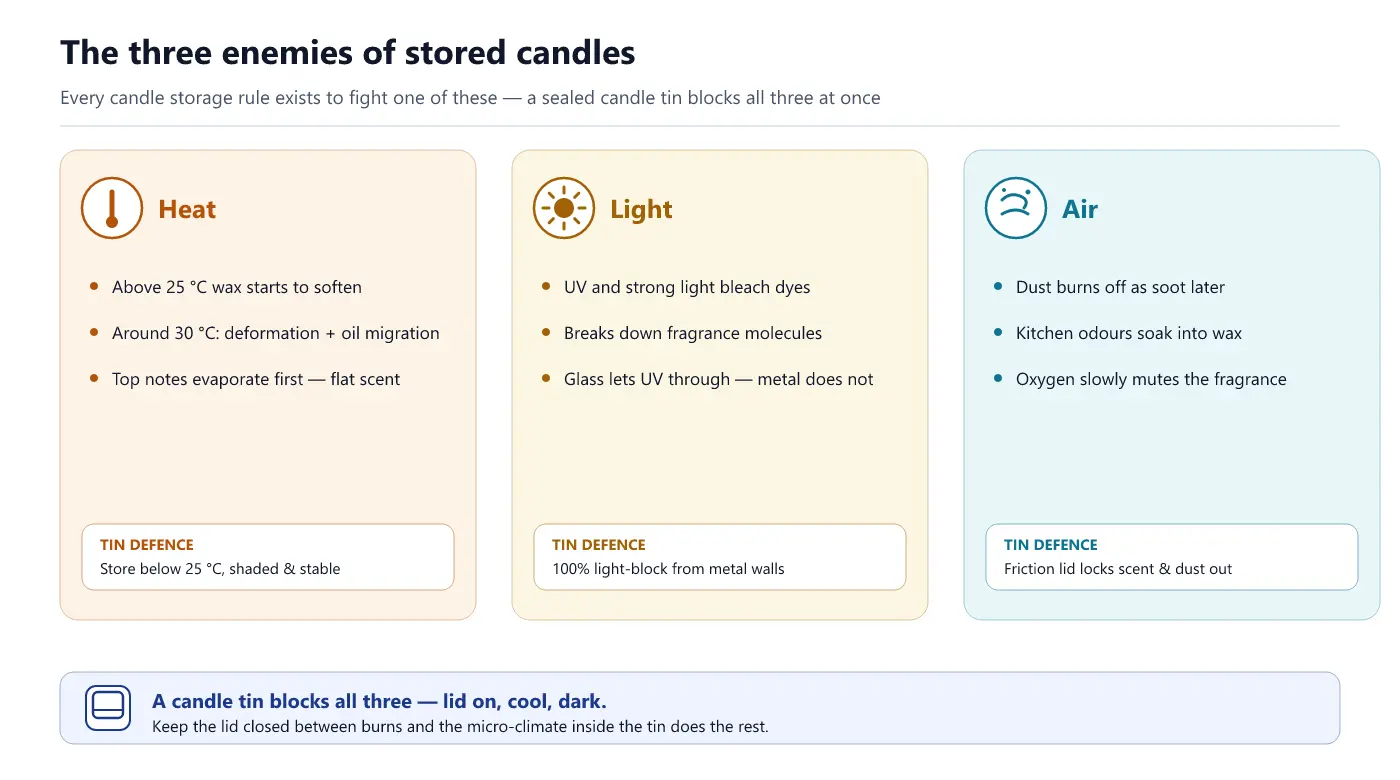
Every rule in this guide exists to defeat one of three enemies. Understand what each one does, and the rules stop being a list to memorise.
A closed candle tin keeps all three enemies out at once — Floral Aromatherapy Candle Tin case.
The three enemies of stored candles — and why one sealed candle tin blocks all of them at once.
Heat: the fastest saboteur
Above roughly 25 °C wax begins to soften; around 30 °C it deforms and fragrance oils start migrating to the surface. That's why a candle kept on a sunny windowsill or in a warm delivery van comes out wrinkled, oily and quiet. Heat also accelerates scent loss — the volatile top notes evaporate first, leaving a flat, unbalanced burn. A car parked in summer sun can pass 50 °C: one afternoon is enough to ruin a candle.
Light: the quiet bleaching agent
UV and strong visible light fade dyes and break fragrance molecules down. This is where metal packaging has a decisive advantage: a tin blocks 100% of light. Even amber glass transmits enough UV over a few weeks on a bright shelf to dull a candle's colour.
Air: dust, odours and oxidation
Open wax absorbs whatever surrounds it. Dust lands on the surface and burns off later as soot; kitchen smells — spices, frying, onions — soak in permanently; oxygen slowly oxidises fragrance oils and dulls the top notes. The deciding factor here is seal quality, not just material.
The 30-second storage checklist
If you remember nothing else, remember this — it is the whole guide:
Lid on whenever the candle isn't burning — a friction-fit lid locks scent in between uses.
Below 25 °C, ideally 15–20 °C — pick the most temperature-stable room you have.
Out of direct light — a drawer, a cupboard, or simply a closed tin.
Stack no more than 3–4 tins, and never put weight on warm wax.
First in, first out — plan stock to sell through within 12–18 months.
Strong scents stored apart — mint next to vanilla without a seal gives you minty vanilla.
The 30-second decision flow: run every storage or shipping decision through these five checks before the wax leaves your hands.
The five storage rules that protect scent and shape
1. Keep the lid closed between burns
The cheapest storage technology ever invented is a well-fitting lid. A friction-fit slip lid keeps the micro-climate inside the tin stable, so fragrance oils stay in the wax instead of slowly escaping into your wardrobe. Blow out, let the wax set, close the lid — that one habit preserves scent better than any expensive additive. Not sure which lid type seals best? See tin lid types explained: slip, clamp, screw, window and hinged.
2. Hold a steady 15–20 °C
The ideal candle storage temperature is a stable 15–20 °C, and never above 25 °C for long. Stability matters more than the exact number: repeated warm-cold cycles cause frosting and condensation inside the tin.
Closed, shaded, temperature-stable — the three conditions every candle wants. Real production record: Green Grass Candle Tin Can case.
Where your storage spot sits on the temperature scale — and why a stable bedroom beats a swinging "perfect" spot.
3. Pick the right spot (and skip the fridge)
Practical spots make or break the rules above. Here is the honest verdict on the places candles actually end up:
The spot-by-spot verdict — most "bad" locations fail on heat swings or odours, not on looks.
What about the fridge or freezer? It's the most common question, and the honest answer is: don't. Refrigeration causes condensation on the wax every time you take the candle out, and that moisture film dulls scent throw and can crack the wax. If a candle must travel through heat, a short stay in a cool room with the lid on achieves more with none of the risk.
4. Don't stack tins on warm wax
Weight pressing on softened wax ruins both the wax surface and, over time, the tin wall. In retail storage, stack 3–4 tins maximum and support them rim-to-rim rather than lid-on-wax; in transit, use dividers or trays so tins carry load on their rims.
5. Rotate stock, and separate strong scents
Even in a perfect tin, fragrance intensity slowly declines — noticeable after 12–18 months. Date every batch, keep older batches at the front, and plan promotions around stock approaching its first birthday. And keep mint away from vanilla: wax absorbs neighbouring odours through any air gap. Inside a properly airtight tin canister that risk drops to nearly zero — one reason serious candle lines have moved from open boxes to lidded tins.
Wax melts storage: same rules, one twist
Wax melts are even more exposed than poured candles — no container, pure wax, maximum scent-releasing surface. Two adjustments:
One scent per tin. Melts pick up neighbouring odours faster than candles, so give every fragrance its own dedicated sealed tin — no cross-contamination accidents.
Snap bars and clamshells sit steadier in deeper tins; shallow tins suit flat melt cups. And the sealed lid is a genuine shop-floor demo: open it in front of a customer and the scent hits all at once.
One sealed tin per scent keeps wax melts pure — Cute Fun Aromatherapy Tin case.
If you sell candles and melts together, consider a nested set: the melts tin fits inside the larger candle tin. It reads as a gift box, protects the melts in transit, and gives retail buyers one SKU instead of two.
Why a tin beats glass and plastic for candle storage
When you choose packaging, storage performance is the first filter. We compared the three materials in depth for food in tin vs plastic vs glass: which container is best; for candles the verdict looks like this:
Property
Tin
Glass
Plastic
Light blocking
Complete
None (even amber passes UV)
Partial
Seal with a good lid
Excellent (friction-fit)
Good (needs a gasket)
Inconsistent
Transit heat tolerance
Durable — dents, never shatters
Fragile
Warps when warm
Scent retention
Strong — metal carries no odour
Strong
Weak — plastic absorbs and re-releases smells
Weight and freight
Light
Heavy
Light
End of life
Infinitely recyclable, reusable
Recyclable
Limited
Two practical consequences: a tin survives courier networks that shatter glass jars, and a candle that arrives intact is one refund you never have to process.
Tins block light completely and survive transit that glass cannot — see Light Floral Scent Candle Tin case.
Choosing a candle tin that protects by design
Storage performance is decided by design decisions made before the first pour. Three matter most.
Lid type decides the seal
For scent-forward candles and melts, a friction-fit slip lid is the default — the tightest seal. Hinged lids are easier to reopen (great for reuse and display) but seal slightly less hermetically; clamp lids sit between the two. Match the closure to the product: melts and votives need the tightest seal, a large pillar candle stored upright can use a looser nesting lid. The full trade-offs are in tin lid types explained.
Size, headspace and your burn profile
A tin sized close to the net wax fill leaves minimal headspace — less air above the wax between burns, slower scent loss, less dust landing. When planning a new line, start from candle tin sizes and shapes: a buyer's guide to match the diameter to your wick's melt pool, or filter by shape, capacity and lid type directly in the 4,000+ ready-made mould library. Shallow, wide tins suit multi-wick candles; tall canisters suit long-burn decorative scented candles.
Shallow round tin with a slip lid: minimal air above the wax. Production details: Light Scent Candle Tin case.
A tall canister form for long-burn scented candles — Vanilla Tall Aromatherapy Tin case shows the full production run.
Coating matters for reuse
If your wax uses natural additives (soy, coconut, beeswax blends) — or you plan to market the tin as reusable for food afterwards — specify a food-grade interior coating. The coating that keeps biscuits tasting right also keeps candle fragrance pure; the options are laid out in food-grade tin cans: safe, airtight storage.
For candle brands: shipping and warehouse survival
Most "poor quality candle" reviews are born in a delivery van. Summer parcels on tarmac can exceed 50 °C, and one hot afternoon is enough to slacken a candle. Practical defences:
Ship in cooler seasons where possible, and use insulated liners during summer months.
Don't high-stack pallets; keep candles off top decks and away from container doors.
Test before launch: leave one packaged unit in a parked car for an afternoon. If it survives, it will survive the courier network.
Put a care card in every tin. Customers who know the "lid on, out of the sun" rules return far fewer candles.
Holiday sets stack beautifully on the shelf — but in transit they need rim-to-rim support. See the Christmas Candlelight Bowl Tin case.
The afterlife: cleaning, reuse and refills
Storage advice doesn't end when the candle does — that's where it starts paying you back. Cleaning a finished tin takes two minutes: warm the tin slightly so the remaining wax loosens, wipe it out with a paper towel, wash with warm soapy water, dry. The clean reusable tin container then lives on as a tea caddy, sewing kit, battery box, spice tin or plant-pot tray — and every one of those roles is a brand impression that lasts years.
The candle burns out, the tin stays: embossed designs like the Emerald Shining Star Tin are built for a second life.
Brands can push the loop deliberately: emboss "100% refillable" on the lid, tuck a reuse-ideas card inside, or run a bring-back refill programme. More second-life inspiration lives in our guide to reusable metal storage tins. And because metal is infinitely recyclable, the reuse story is a genuine sustainability claim — not greenwashing.
Real production examples from the case library
Theory is cheap — here is what these rules look like in production. Our library holds 2,839 real cases, including 52 dedicated candle tin cases, each with actual tooling, printing and finishing records worth studying:
Blue Elegance Candle Tin — a friction-fit gift tin with a deep skirt that buffers temperature swings.
Oblate tins read clearly on a retail shelf — browse the full candle tin case collection or all 2,839 packaging cases.
A gift-format candle tin with a deep-fitting lid — see how it was made in the Blue Elegance case.
Already have a tin concept? The AI material visualisation tool shows your design across different finishes before you commit to sampling.
FAQ: candle storage questions, answered
What is the best temperature to store candles?
A stable 15–20 °C is ideal; avoid long spells above 25 °C. Stability matters more than the exact number — repeated warm-cold cycles cause frosting and condensation inside the tin.
Can I store candles in the fridge or freezer?
Not recommended. Every trip out of the fridge causes condensation on the wax, which dulls scent throw and can crack the candle. A cool room with the lid closed protects better with none of the risk.
How long do candles last in a sealed tin?
Stored below 25 °C, out of light and with the lid closed, most scented candles keep good fragrance strength for 12–18 months; a friction-fit seal slows the fade further.
Why is my candle frosted, and can I fix it?
Frosting is recrystallised wax triggered by temperature swings — cosmetic, not mould, and it burns normally. Stabilise the storage temperature and use a close-fitting lid to reduce it; a heat gun on low briefly smooths the surface.
Why does my scented candle smell weak after a few weeks?
Air exposure, light and warmth evaporate the volatile top notes first. Close the friction lid between burns, move the candle out of sunlight, and store it below 25 °C — then the remaining scent recovers noticeably.
Can I store different wax melt scents in one tin?
Only if you enjoy blended fragrances. Melts absorb neighbouring odours faster than poured candles, so give each scent its own sealed tin.
Are candle tins reusable for food afterwards?
Yes, when produced with a food-grade interior coating — cleaned tins work as spice or tea tins. Specify food-grade coating when ordering if food reuse is part of your marketing.
How do candle brands stop candles melting in shipping?
Ship in cooler seasons or use insulated liners in summer, avoid high stacking, and test one packaged unit in a parked car for an afternoon before launch — if it survives that, it survives the courier network.
Conclusion: storage *is* product design
A candle tin isn't a box — it's your product's climate control system. Lid closed, steady 15–20 °C, sunlight blocked, stock rotated within 12–18 months, and a lid type and size that give the scent nowhere to go. Do that, and the tin keeps selling long after the first burn: on the shelf, in the parcel, and for years afterwards as a storage tin on someone's shelf.
About CNTINWORLD: an intelligent tin packaging design platform that connects moulds, real production cases, AI creativity, customisation and instant quoting in one workflow — tin packaging manufacturing since 1997.